uae-bookkeeping.com

UAE Bookkeeping Requirements Explained (2026 Guide): Mainland vs Free Zone Businesses
UAE Bookkeeping Requirements Explained (2026 Guide): Mainland vs Free Zone Businesses
Gupta Group International
1/21/20265 min read


UAE Bookkeeping Requirements Explained (2026 Guide): Mainland vs Free Zone Businesses
Running a business in the United Arab Emirates (UAE) comes with tremendous benefits — from 0% tax regimes to world-class infrastructure and full foreign ownership in many jurisdictions. However, it also brings critical financial compliance obligations that every business must satisfy before they can fully enjoy these advantages.
In this comprehensive 2026 guide, we’ll unpack everything you need to know about bookkeeping requirements in the UAE, with a special focus on the differences between Mainland and Free Zone businesses. Whether you’re launching a new company, expanding in the UAE market, or simply looking to stay compliant, this article provides clear, actionable insights into what the law expects — and how proper bookkeeping can future-proof your business.
Why Bookkeeping Is Non-Negotiable in the UAE
From tax compliance to licensing and audit obligations, bookkeeping isn’t an optional admin task — it’s a legal requirement.
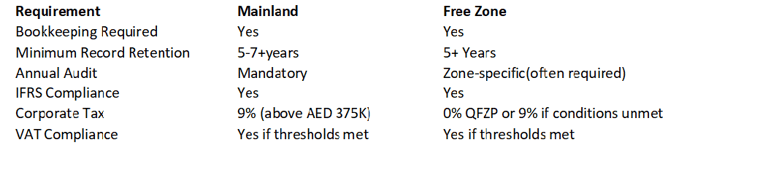
Under the UAE’s Commercial Companies Law, every registered company must maintain accurate financial records that reflect its financial transactions. These books must be retained for a significant period — at least five years from the end of the financial year.
But why does this matter?
Legal Compliance: You must maintain financial records that accurately reflect your company’s financial position and transactions as mandated by UAE law.
Tax Obligations: If your business is subject to VAT or Corporate Tax, you’ll need compliant bookkeeping to support returns, audits, and inspections.
Audit Requirements: Many businesses — especially larger ones or those in specific free zones — must prepare audited financial statements each year.
Bank & Investor Confidence: Banks and investors expect accurate records as a cornerstone of financial credibility.
Poor bookkeeping can result in fines, audit delays, rejected tax filings, and even license renewal issues. In extreme cases, it can jeopardize your business continuity.
Core Bookkeeping Requirements Across the UAE
Although specifics vary by jurisdiction, the UAE maintains several consistent bookkeeping principles:
1) Maintain Complete Accounting Records
All businesses must keep records that accurately reflect:
Sales and purchase invoices
Bank statements
Receipts and payment vouchers
Payroll and employee records
Ledger books and journals
Tax records and returns
These must be stored for a minimum of five years from the end of the fiscal year, while tax-related documents such as Corporate Tax documentation may need to be retained for up to seven years or more, especially where audits or disputes occur.
2) Follow Accepted Accounting Standards
Financial statements must generally be prepared in compliance with International Financial Reporting Standards (IFRS) or IFRS for SMEs where appropriate.
3) Prepare Annual Financial Statements
Most businesses — mainland and many free zones — must produce annual financial statements, including:
Balance sheet
Profit & loss statement
Cash flow statement
Notes to the accounts
These statements are essential for audits and tax computations
4) VAT Record Keeping
If your business is VAT-registered (mandatory when taxable supplies exceed AED 375,000 annually), you must retain:
VAT invoices
VAT returns
Supporting documentation
Minimum retention: typically 5 years.
5) Corporate Tax Readiness
With Corporate Tax active since June 2023, companies must keep records that substantiate tax computations and financials for at least seven years after the end of the tax period.
Mainland Companies: Requirements & Expectations
A Mainland business operates outside free zones and can conduct trade directly within the UAE market — without restrictions. While this brings opportunity, it also comes with more rigorous compliance.
1) Mandatory Audits
Mainland companies are generally required to have annual audits, often performed by auditors licensed by the Ministry of Economy. These audited financial statements must align with IFRS and be submitted according to regulatory timelines.
2) Longer Record Retention
Mainland businesses must retain records for at least seven years for tax purposes and five years for general accounting purposes.
3) Commercial Companies Law Compliance
Under Federal Decree-Law No. 32 of 2021, mainland companies must ensure books “accurately reflect” transactions and financial positions — a standard that auditors will enforce
Free Zone Companies: What’s Different?
Free zones are popular for their tax incentives, 100% foreign ownership, and simple setup procedures. But with benefits come administrative responsibilities — including bookkeeping.
1) Mandatory Bookkeeping
Although historically some free zones offered more flexibility, today all free zone companies must maintain accurate books of accounts. This ensures compliance with Corporate Tax and VAT laws and supports audit requirements where applicable.
2) Audit Requirements Vary by Zone
Some free zones — like DMCC, JAFZA, DAFZA, and RAKEZ — require annual audited financial statements as part of license renewal. Others may only require periodic financial statements without a mandatory audit, but this is increasingly rare.
3) Qualifying Free Zone Person (QFZP) Conditions
To enjoy 0% Corporate Tax benefits as a QFZP, companies must demonstrate:
Adequate substance in the free zone
No mainland UAE income
Compliance with accounting/reporting requirements
Failing these criteria can result in losing tax benefits and being taxed at 9%.
4) Record Retention and Reporting
The fundamentals remain the same: retain financial records for at least five years, prepare IFRS-compliant financials, and be ready for inspection by the Free Zone Authority or Federal Tax Authority upon request.
Mainland vs Free Zone — A Quick Comparison
Consequences of Non-Compliance
Failing to maintain accurate, compliant books can lead to:
Fines and penalties from FTA and authorities
Delays or denial in license renewals
Loss of free zone tax benefits
Difficulty opening or maintaining bank accounts
Audit challenges with local authorities
This reinforces that bookkeeping is not just an administrative task — it’s a foundation of financial health and legal compliance.
Practical Steps to Maintain Compliance
Here’s how UAE businesses can strengthen their bookkeeping processes:
1) Use Cloud Accounting Software
Tools like Xero, QuickBooks, and Zoho help automate entries, reconcile bank statements, and prepare VAT-ready data.
2) Schedule Monthly Reviews
Reconcile books monthly instead of waiting for year-end — it’s easier and keeps data audit-ready.
3) Hire Qualified Professionals
Certified accountants and bookkeeping experts understand local standards and ensure your reporting aligns with UAE laws.
4) Maintain Digital and Physical Records
Even with digital adoption, maintain organized backups of invoices, contracts, and statements for audits.
2026 Trends You Need to Watch
Looking ahead:
E-Invoicing Requirements: The UAE is enforcing digital invoicing from July 2026, underlining the shift toward automated, accurate financial records.
Mainland-Free Zone Integration: New policies allow free zone companies to operate more seamlessly on the mainland — but this requires dual bookkeeping clarity for income sources.
Corporate Tax Expansion: As more businesses enter the corporate tax regime, accurate books become non-negotiable for compliance and strategic tax planning.
Final Thoughts: Bookkeeping Is More Than Compliance — It’s Strategy
From tax readiness to bank credibility and strategic decision-making, bookkeeping is the backbone of your business’s financial integrity in the UAE.
Whether you operate on the Mainland or within a Free Zone, understanding your bookkeeping obligations is essential — not just for legal compliance, but for long-term success.
Take the Next Step With UAE-Bookkeeping.com
Are you ready to simplify your UAE bookkeeping process and stay compliant in 2026 and beyond?
Get a Consultation with our certified bookkeeping experts now
Request a Custom Bookkeeping Plan for Mainland or Free Zone
Download Our 2026 Compliance Checklist
📩 Contact us today at info@guptagroupinternational.com
or fill out the contact form on our website to start your compliance journey with confidence.
© 2026 uae-bookkeeping.com
